Why does food temperature control get harder during off-site catering transport?
The drive from your kitchen to the venue is where safe food quietly becomes unsafe. Here is what changes in transit, how to plan for it, and how to document it on the BEO.
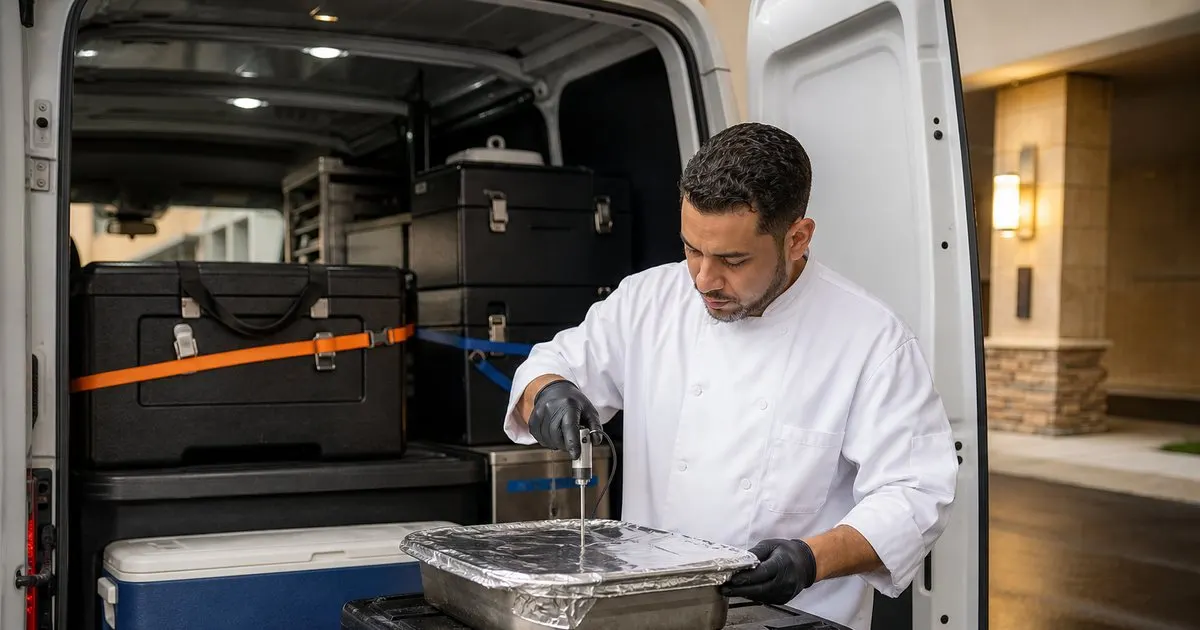
What changes the moment food leaves the kitchen
In your kitchen, temperature is a system: walk-ins, ovens, and holding cabinets keep food where it belongs without anyone thinking about it. The moment a hotel pan goes into a van, every one of those systems is replaced by insulation and time. Insulated carriers do not heat or cool; they slow the drift. A hot box loaded with food at the right temperature will lose heat through every door opening, every stop, and every minute the van sits on a loading dock waiting for an elevator. Cold food in coolers behaves the same way in reverse.
The FDA Food Code, which most state and local health departments adopt in some form, treats cold holding at 41°F or below and hot holding at 135°F or above as the standard limits, with the range between them as the zone where bacteria grow fastest. Your local code may differ slightly. What matters operationally is that transport time counts against you and that you rarely have a way to correct a drift once you are on the road. Planning, not equipment alone, is what keeps the food safe.
Keep reading: From Inquiry to Booked Catering Event, Writing a Catering Proposal That Wins, What a Banquet Event Order Needs. See how CaterLoom helps you catering proposals and banquet event order generator.
Planning the load around time and temperature
Start by building a realistic transport timeline into the BEO: departure time, expected drive, load-in duration, and time until service for each item. Then work backward. Items that will sit longest should be the most robust: braises, roasted vegetables, and grain dishes hold far better than delicate proteins or anything with a crisp texture. If a dish cannot survive the projected hold, change the dish or change the plan, such as finishing on site with portable induction or transporting components cold and heating at the venue. Related: What should a caterer check during a venue walkthrough before the event?
Preheat hot boxes and prechill coolers before loading; a cold cabinet pulls heat out of the first pans that go in. Load hot and cold in separate carriers, pack tightly so pans do not shift and vent, and limit door openings by staging so the first items needed are the last loaded. Bring backup heat and ice: extra sternos, a spare propane cylinder if you use one, and more ice than you think you need. Cheap insurance beats a discarded entree.
Measuring instead of hoping
A probe thermometer and a simple log turn guesswork into evidence. Take and record temperatures at three points at minimum: leaving the kitchen, arriving at the venue, and immediately before service. If an item is drifting, you learn it while there is still time to reheat, rechill, or swap it out, rather than discovering it when a guest does. Many health departments expect a log for off-premise events, and even where they do not, a log is your best defense if a complaint ever arises. Related: Coordinating Kitchen and Service
Build a corrective action rule into your kitchen standard practice so nobody has to make a judgment call under pressure. Define what happens when a hot item arrives below your threshold (reheat to a safe internal temperature if it has been out of range only a short time, and discard it if it has been out of temperature longer than that) and when a cold item arrives too warm. The FDA Food Code also allows time as a control for some foods under specific conditions, but that approach needs written procedures and is not a substitute for temperature control on a long drive.
Putting it on the BEO where the crew will see it
Temperature planning fails most often not because nobody knew the rules but because the people loading the van did not know the timeline. The BEO should list, per item, the holding method (hot box, cooler, refrigerated truck, ambient), the target temperature, and any finishing step at the venue. Include the equipment count so the loader knows how many carriers to stage and the driver knows what must go in first. A single line reading "transport hot" is not a plan. Related: How many servers does a plated dinner for 150 guests actually need?
Assign a named person responsible for the temperature log on each event and note it on the BEO. When the log lives on the same document as the menu, the timeline, and the equipment list, it becomes part of how the event is run rather than a form filled in afterward. Review the logs after busy weekends; patterns like one route that always runs long or one carrier that always underperforms are the kind of operational knowledge that keeps a caterer out of trouble. Related: How much of a deposit should a caterer collect before locking a date?
- Insulated carriers only slow temperature drift; the drive and load-in time count against you.
- Plan menus and holding methods around the real transport timeline, and change dishes that cannot survive it.
- Log temperatures at departure, arrival, and pre-service, with written corrective actions.
- Put holding method, target temperature, and equipment counts per item on the BEO.

Julien Jimenez
Julien Jimenez is an independent software builder based in Paris. He designs, ships, and operates focused SaaS products for small businesses and independent professionals. Read the full author page.
From proposal to banquet order in one flow
Catering proposals and banquet event order generator. CaterLoom is built to help you put this into practice.
Build a proposalMore from the CaterLoom blog

From Inquiry to Booked Catering Event
Writing a Catering Proposal That Wins
What a Banquet Event Order Needs
Get the CaterLoom playbook
Practical guides on catering operations, straight to your inbox as we publish them. No spam, unsubscribe any time.