How many servers does a plated dinner for 150 guests actually need?
Staffing ratios are a starting point, not an answer. Here is how to build a server count from the menu, the room, and the timeline, and how to price it without losing the job.
Why a ratio is only the first draft
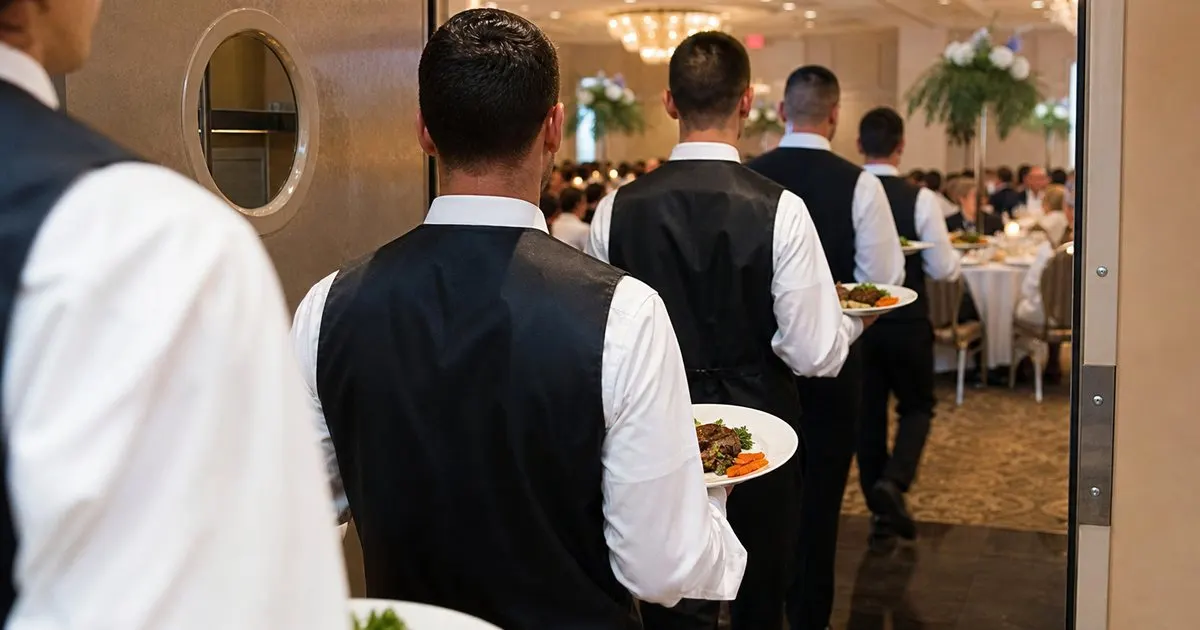
Ask ten caterers how many servers a plated dinner needs and most will quote a ratio, often somewhere around one server for every eight to twelve guests, with buffets and stations needing fewer. Those numbers are a fine place to start and a poor place to stop. A ratio assumes an average room, an average menu, and an average timeline, and almost no event is average on all three. The real question is how many hands are needed at the busiest ninety seconds of the night, which is usually the moment an entree course drops. Related: What a Banquet Event Order Needs
For 150 guests at rounds of ten, that is fifteen tables. If you want the entree on every table within a tight window so the food is hot and the room finishes together, each server needs to carry to a manageable number of tables and return for the next tray. Work backward from that: how many plates can one server carry or tray-jack at once, how far is the kitchen, and how many trips does each table take? That arithmetic, not a ratio, tells you whether you need twelve servers or eighteen.
Keep reading: From Inquiry to Booked Catering Event, Writing a Catering Proposal That Wins, What a Banquet Event Order Needs. See how CaterLoom helps you catering proposals and banquet event order generator.
Menu and service style change the count
A three-course plated menu with a synchronized drop, wine service, and a cheese course needs substantially more floor staff than a two-course plated menu with a preset salad and self-serve dessert. Each element you add to the table (bread service, poured wine, coffee at the table, a family-style platter that needs replacing) adds trips. Synchronized service, where every plate at a table lands at once under a captain's cue, is beautiful and labor intensive; it typically means one server per table for the drop, with support staff clearing behind.
Do not forget the positions that are not carrying plates. A plated dinner for 150 usually needs a captain or floor lead, one or two bartenders depending on the bar program, and back-of-house support: a dish or pit person, a kitchen expediter, and someone on the pass. Bussers or runners who only clear and reset free the servers to focus on the drop. Count all of these roles separately in the BEO, with arrival and release times, rather than folding them into one vague "staff" line.
The room and the timeline
Distance is labor. A kitchen fifty feet from the room with a straight path lets one server manage more tables than a kitchen down a hallway and up a service elevator. Outdoor tents, historic homes, and multi-level venues all push the count up. So does a timeline with tight turns: if the client wants dinner served, cleared, and the floor open for dancing within seventy-five minutes, you need enough people to clear as fast as you served. A looser evening with speeches between courses gives the same crew more time to breathe. Related: Coordinating Kitchen and Service
Build the staffing plan against the actual minute-by-minute timeline and the floor plan, then stress-test the pinch points. Where will the servers stage trays? Can they get back into the kitchen while the next wave is coming out? Is there a separate door for clearing? If the answer to any of those is no, add people or change the service style. A plan that looks fine on paper but assumes perfect flow will fail on the night, and the client will remember cold food, not your ratio.
Pricing the staff without losing the bid
Staff hours are one of the most visible lines on a proposal and one of the first a price-sensitive client attacks. Resist the urge to trim the count to win the job; you will pay for it in service quality and in tips your crew did not earn. Instead, show the plan: list positions, hours, and what each role does, so the client sees a staffed event rather than a number. If the total is too high, offer real trade-offs with visible consequences, such as a preset first course, a two-course menu, or a buffet for dessert. Related: When should a caterer offer a tasting, and who should pay for it?
Include setup and breakdown hours honestly. A server who arrives four hours before guests to set tables and leaves two hours after the last dance is billed for the whole shift, and your proposal should reflect that rather than hiding it in a service charge. Add a clear overtime clause tied to the vendor end time on the BEO. When the plan, the timeline, and the staffing lines all come from the same document, the client gets one coherent story, and there is far less room for a dispute afterward. Related: Which rentals should a caterer include in the proposal versus leave to the client?
- Start with a ratio, then rebuild the count from the entree drop, table count, and kitchen distance.
- Every extra table element (wine, bread, coffee, family style) adds trips and therefore staff.
- Count captains, bartenders, runners, and kitchen support as separate lines with hours.
- Show the staffing plan on the proposal and offer scope trade-offs instead of cutting bodies.

Julien Jimenez
Julien Jimenez is an independent software builder based in Paris. He designs, ships, and operates focused SaaS products for small businesses and independent professionals. Read the full author page.
From proposal to banquet order in one flow
Catering proposals and banquet event order generator. CaterLoom is built to help you put this into practice.
Build a proposalMore from the CaterLoom blog
From Inquiry to Booked Catering Event

Writing a Catering Proposal That Wins
What a Banquet Event Order Needs
Get the CaterLoom playbook
Practical guides on catering operations, straight to your inbox as we publish them. No spam, unsubscribe any time.